How Australians living with Myasthenia Gravis are shaping the future of MG treatment decisions
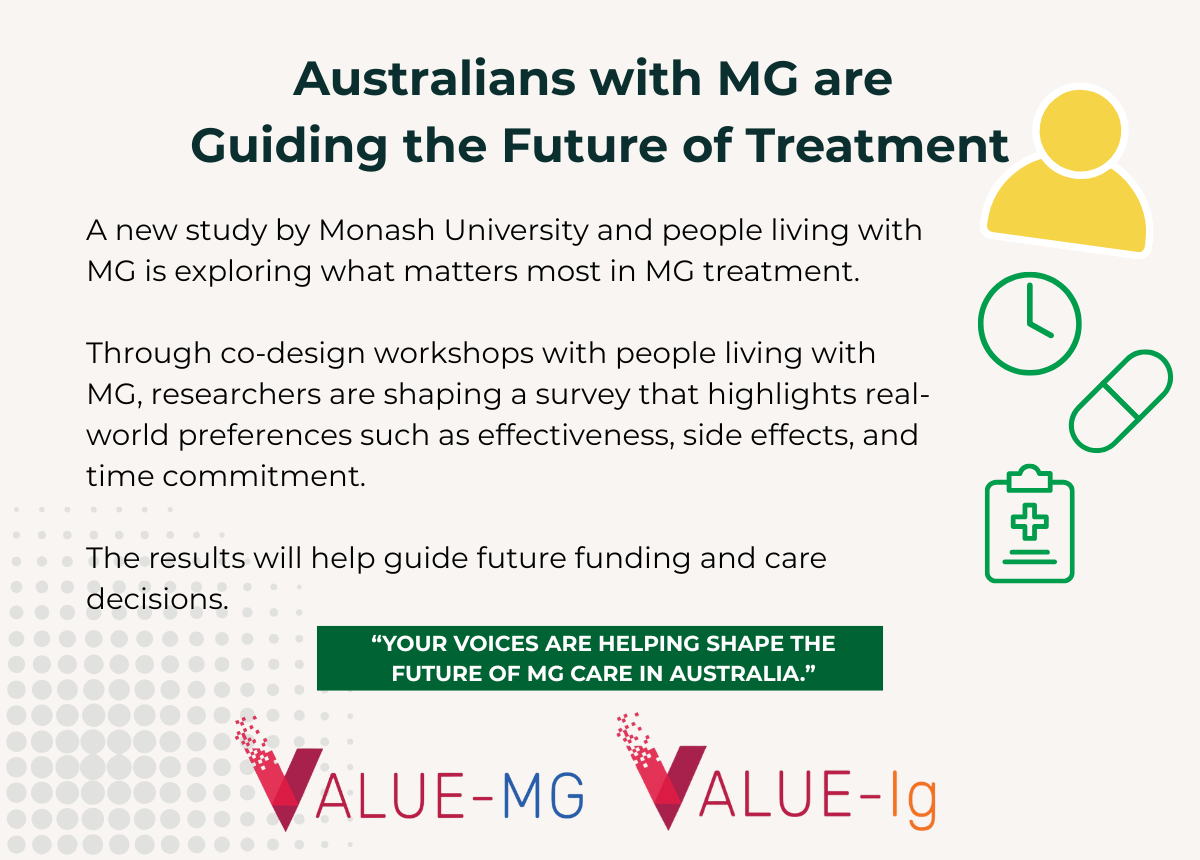
The VALUE-MG research team have provided an update on an important co-designed study that is looking at what people with MG value most when it comes to treatments.
Thank you to all MG patients who have contributed to this research so far.
Study Update:
How Australians living with Myasthenia Gravis are shaping the future of MG treatment decisions
Our research team at Monash University has been working on a new survey to understand what people with MG value most when it comes to treatments. This type of research helps inform how new treatments are funded and delivered – and this time, it’s being co-designed with patients. Why? Because who better to guide research than those who live with MG every day?
What’s the research about?
The team is developing a Discrete Choice Experiment (DCE) – a type of survey that presents people with real-world scenarios along with different treatment options and asks them to choose their preferred one. These options differ in features such as treatment duration side effects, or how it is administered. The results help researchers and policymakers understand what trade-offs people are willing to make and what drives decision-making.
How the MG community helped
In mid-2024, 19 people with MG from across Australia joined online workshops to co-design the survey.
Over 8 sessions, they:
- Identified the most important features of MG treatments
- Helped refine scenario descriptions
- Suggested better wording for the final survey
The sessions focused on three types of treatment experiences:
- Mild flare-ups
- Severe MG exacerbations (crisis)
- Long-term maintenance treatment
What did patients say?
Effectiveness & Duration of Effectiveness
- Efficiency is particularly crucial during exacerbations.
- Duration of effectiveness is more important for patients receiving maintenance treatment.
Time matters
- Travel time to hospital
- Time spent in hospital
- Duration of the treatment
Side effects matter
- Especially gastrointestinal issues (e.g., nausea, diarrhea)
- Other commonly mentioned side effects included poor sleep, mood changes, and mental health impacts, often linked to steroid use. While some risks, like weight gain, blood clotting, and skin cancer, were noted, their importance varied depending on the severity of the treatment scenario.
Cost? Less important to patients, but important to government, so still included
- Cost to patients and the government were consistently ranked lower by patients.
- The research team still decided to include cost in the future survey because it is important to government and would likely be very relevant for patients if the government choose not to subsidise certain expensive treatments.
What didn’t make the final cut?
Some treatment features were ranked very highly but were excluded from the future survey:
- “Recommended by my neurologist”
- “Healthcare worker knowledge of the treatment”
These came up often in discussions, but were excluded for the following reasons:
- “Recommended by my neurologist” reflects a clinician’s view, not the patient’s personal preference
- “Healthcare worker knowledge” was too broad – people were referring to general MG knowledge across healthcare professions rather than knowledge about a specific treatment
Even though they weren’t included in the survey, they are still important and will be considered when we interpret the final results.
What happens next?
We are working towards finalising the survey, and it will be pilot tested soon. The findings will:
- Help improve shared decision-making between patients and clinicians
- Support evidence-based funding of MG treatments
- Promote patient-centred care in rare disease treatment
Thank you
We want to thank the amazing community members who contributed to this project.
Your voices are helping shape the future of MG care in Australia.
Want to get involved in future MG research?
📧 Contact Dr Gozde Aydin at value.ig@monash.edu